


Growing a community is exciting until keeping it active starts taking up more time and energy than you expected. More members can mean more content to create, more questions to answer, and more conversations to manage.
When every part of the community depends on you, growth eventually becomes difficult to sustain.
The answer isn’t to work harder or make yourself available around the clock. It’s to build systems, habits, and member relationships that allow your community to grow without constantly adding to your workload.
In this guide, we’ll cover seven ways to make community growth more sustainable, along with practical ways to put each one into action.
1. Stop Being the Only Source of Value
One of the fastest ways to burn out as a community builder is to make yourself responsible for everything. You create every post, answer every question, and start every conversation. The community may look active, but all that activity depends on you.
You’ll notice the problem as soon as you step away. If you take a few days off and everything goes quiet, you haven’t built a community that can support itself yet.
Das Ziel ist es help members become active contributors, rather than leaving them as an audience waiting for your next post.
Here are a few ways to encourage that:
- Start conversations instead of only sharing information. Ask open-ended questions, invite members to share their experiences, and give them space to respond to one another.
- Highlight member wins and insights. Share their results, useful comments, lessons, and questions with the wider community. This gives members recognition while creating valuable content for everyone else.
- Encourage peer support. You don’t need to be the first person to answer every question. Give other members a chance to share what has worked for them.
- Create opportunities for members to contribute. Invite them to lead a discussion, share a resource, host a session, or explain how they solved a problem.
The strongest communities feel like a room full of people learning from one another, not a stage where one person does all the talking.
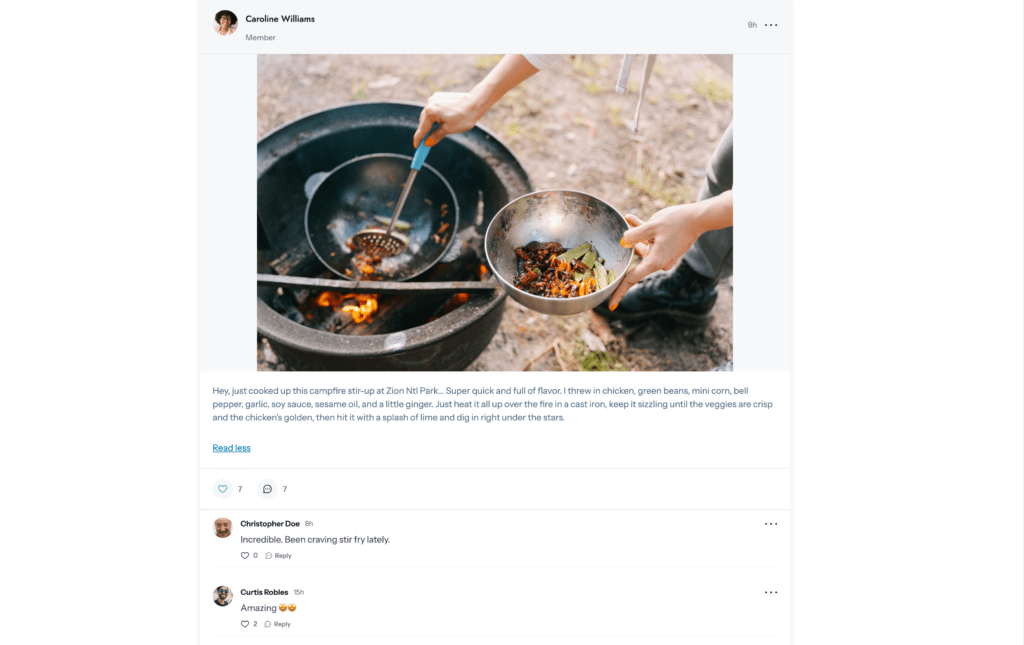
ClubSuite™. gives members a dedicated space to publish posts, join discussions, and support one another. Instead of carrying every conversation yourself, you can focus on guiding the community and creating opportunities for members to participate.
2. Build Rituals That Run Without You
Coming up with a fresh engagement idea every week can quickly become another demanding item on your to-do list. You’re constantly deciding what to post, how to get people involved, and what might bring quiet members back into the conversation.
Recurring community rituals remove some of that pressure. These are activities that happen on a familiar schedule, giving members a reason to return without requiring you to reinvent your approach each time.
You could introduce:
- Weekly discussion threads. Erstellen einer recurring prompt such as “Win Wednesday” or “Question Friday,” where members can share updates, ask for advice, or reflect on what they’ve learned.
- Regular events. Hold office hours, live Q&As, or guest sessions on the same day or at a predictable interval.
- Monthly challenges. Give members a shared goal to work towards, with designated days for updates and a final check-in.
- Themed conversations. Assign certain topics to particular days or weeks so members know what kind of discussion is coming.
A familiar schedule makes participation easier. Members don’t have to wait for you to announce something new, and you don’t have to begin each week with a blank content calendar.
You can make these rituals easier to manage by Terminplanung prompts and events in advance. Automated reminders can also notify members before an activity begins, so you aren’t responsible for repeatedly chasing attendance.
3. Develop Community Leaders
As your community grows, handling every moderation issue, answering every specialised question, and keeping every activity on track becomes difficult. Even if you can manage it now, that approach won’t scale for long.
The good news is that you may already have potential leaders in your community. Look for members who regularly welcome newcomers, offer thoughtful answers, encourage others, or show up consistently. Their behaviour often reveals who is ready for greater responsibility.
Once you identify them, give them a clear role. Depending on your community, they could become:
- Moderatoren who help enforce guidelines and manage discussions.
- Ambassadors who welcome new members and encourage participation.
- Mentors who support members with less experience.
- Resident experts who answer questions in a particular area.
Make the role visible with a title, badge, special access, or another small perk. Recognition shows that their contribution matters and helps other members understand who they can turn to for support.
Most importantly, allow your leaders to lead. Set expectations, provide basic guidance, and then give them room to make decisions within their role. Delegating responsibility won’t save you much time if every action still needs your approval.
Perhaps one member already welcomes newcomers, answers questions, and helps keep discussions productive. With ClubCircles™., you can make that contribution official by promoting them to a Circle Moderator and deciding which moderation permissions they should have.
4. Automate Repetitive Tasks
Some community tasks need your attention and judgement. Others follow the same process every time, regardless of who the member is. Doing those routine jobs manually can take up hours that would be better spent improving the community itself.
Start by identifying tasks you repeat whenever someone joins, reaches a milestone, or approaches the end of a subscription. These are often the easiest areas to automate:
- Member onboarding. Willkommens-E-Mails senden, direct new members to a “Start Here” page, and provide guidance during their first week.
- Renewal communication. Notify members before a payment is due, after a transaction fails, or when their access is about to expire.
- Milestone messages. Acknowledge anniversaries, course progress, or other meaningful points in the member journey without tracking each one yourself.
- Content delivery. Release lessons, resources, or training materials gradually through a drip schedule instead of sending them manually.
Automation doesn’t make a community less personal. It takes care of predictable communication so you can give individual attention to situations that genuinely need it.
MemberPress kann automate emails, Tropf-Inhaltund Zugriffsregeln based on a member’s subscription or progress. Once these workflows are in place, they continue working as new people join and move through your community.
5. Set Boundaries and Keep Them
Being accessible to your members can help you build trust, but constant availability quickly becomes exhausting. When questions arrive through direct messages at all hours, even a small community can begin to feel like a full-time support desk.
Set clear expectations around when you’re available and where members should ask for help. For example:
- Create office hours. Choose a regular time for live questions, such as Thursday afternoons, rather than responding whenever a message arrives.
- Direct questions to shared spaces. Encourage members to post in the community instead of sending private messages. Your response can then help anyone with the same problem.
- Establish response windows. Let members know how often you check discussions and how long they can expect to wait for a reply.
- Decide what requires your involvement. Not every question needs a personal response from you, especially when another member or an existing resource can provide the answer.
Once you’ve communicated these boundaries, follow them consistently. Replying outside the hours you’ve set may seem helpful, but it teaches members that your availability is flexible.
Pin your availability guidelines somewhere easy to find and schedule regular office hours for questions that need direct support. Clear boundaries help members know what to expect while giving you space to step away without feeling guilty.
6. Create Evergreen Assets That Keep Working
If members keep asking the same questions, you may find yourself rewriting the same answer several times a week. The same problem arises when each new group needs identical instructions, templates, or training.
Instead of starting from scratch every time, turn recurring guidance into resources members can use on their own. Useful evergreen assets include:
- An FAQ or knowledge base. Collect clear answers to common questions and organise them so members can find the right information quickly.
- A resource library. Store templates, guides, checklists, and recordings in one accessible location.
- An onboarding course. Walk new members through the community, its resources, and their next steps without requiring individual guidance.
- Recorded workshops. Save useful live sessions so future members can benefit from them long after the original event.
Pay attention to the questions that appear repeatedly in discussions, emails, and support requests. Each one points to a resource you could create once and refer members to later.
MemberPress-Kurse can house onboarding lessons and other educational material, while access rules help you control which resources are available to each membership level.
New members can find the guidance they need without waiting for you to provide it personally.
7. Design for Compounding, Not Just Adding
Community growth becomes unsustainable when every new member adds another question, task, or responsibility to your workload. A healthier model is one where each person also brings knowledge, experience, and support that benefits others.
That’s what compounding growth looks like. As the community expands, its value increases without demanding the same increase in effort from you.
You may begin to notice that:
- Existing members help newcomers. New members can receive useful answers and encouragement without relying solely on you.
- Shared resources continue to grow. Discussions, member contributions, and recorded sessions create a larger pool of knowledge over time.
- Community norms become established. Members understand how to participate, where to find support, and how to treat one another.
- Growth no longer creates equal amounts of work. Your systems and community leaders absorb much of the additional activity.
This doesn’t happen through one feature or tactic. It comes from combining the foundations we’ve covered: encouraging member contributions, establishing rituals, developing leaders, automating routine tasks, setting boundaries, and creating evergreen resources.
As your community grows, members should be able to find the right people and conversations without waiting for you to connect them.
ClubDirectory™. helps members discover one another, ClubCircles™. gives them shared spaces to exchange ideas, and ClubConnect™. supports direct conversations when they need to take things further.
Together, these tools make it easier for relationships and support to grow alongside your membership.
Grow Your Community at a Sustainable Pace
A growing community shouldn’t require you to work longer hours or make yourself available at all times.
By sharing responsibility, creating predictable routines, and reducing repetitive work, you can give members a valuable experience while protecting your own time and energy.
You don’t have to apply every strategy at once. Start with the part of community management that currently takes the most out of you, then put one change in place that makes it easier.
Mit MemberPress and ClubSuite™, you can manage your memberships, content, and conversations from your own WordPress website. Bring your community home and create an experience that can grow with your members without placing all the work on you.
What’s the biggest drain on your energy as a community builder? Let me know in the comments.
Wenn Sie diesen Artikel hilfreich fanden, folgen Sie uns auf Facebook, X, Instagramund LinkedIn!

Holen Sie sich MemberPress noch heute!
Lassen Sie sich für die von Ihnen erstellten Inhalte bezahlen.






 DE
DE  EN
EN  ES
ES  FR
FR  PT
PT 
Einen Kommentar hinzufügen