

Tamara Morrison walked away from eight years of freelance client work to build Thirty One Palms Studio, a templates-and-membership business she owns outright, files and code included. She’s confident the AI slop flooding everyone’s feed is about to make businesses like hers more valuable, not less.
Watch The Full Interview
Becoming Your Own Boss
Tamara Morrison has sold more than 15,000 templates through Thirty One Palms Studio, a mix of one-off Canva and website templates plus a paid membership, the Business Template Collective.
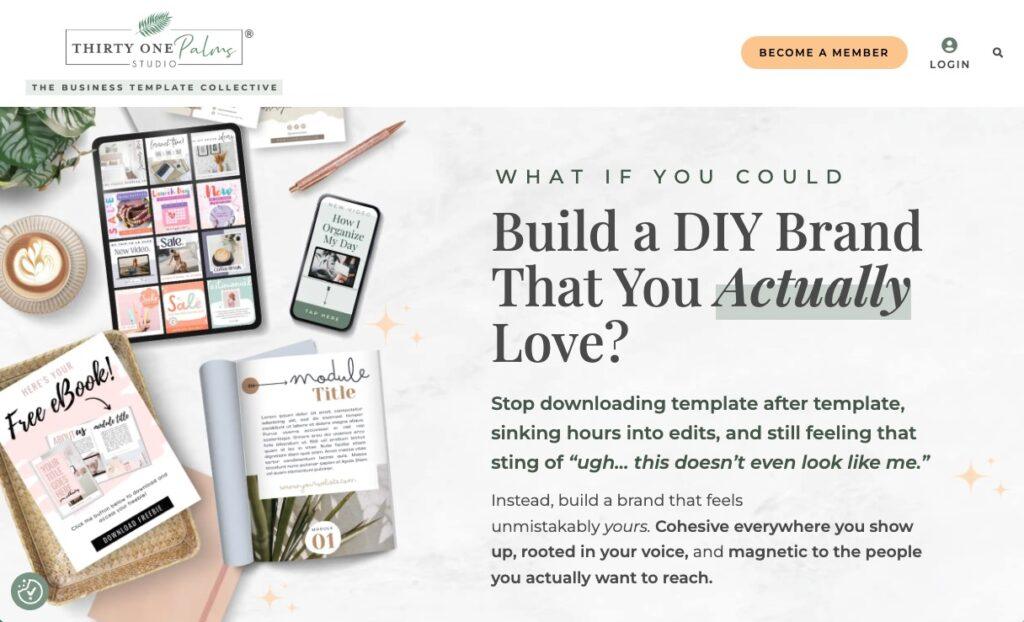
Solopreneurs, coaches, VAs managing multiple client brands, online shop owners selling everything from candles to t-shirts: all kinds of people, in industries she says she never would have guessed, use her designs to build their businesses.
She got there by quitting something that was, by her own account, going fine.
Eight years into freelance graphic design, “I would kind of wake up in the morning dread opening my email,” she says. “What do they want now? There’s going to be 10,000 questions and they’re going to be complaining about something.”
The problem wasn’t any one client. It was the shape of the work itself. “I don’t really have a business,” she remembers realizing. “I just have a job with a hundred bosses. Your reward for finishing a project is having to go look for more work. There’s nothing that builds.”
From Burnt Out to Taking Back The Reins
In 2019, still burned out and looking for a way out, Tamara found someone online selling design templates. “She’s not specifically more talented or smarter than anyone else, but she’s selling these templates,” Tamara remembers thinking. “I could do that.”
She started with Photoshop templates for photographers, then switched to Canva once enough customers asked for it.
The timing turned out to be close to perfect: Canva was just becoming a serious platform, and within a year the pandemic sent demand for templates through the roof as people rushed to start businesses from home.
She sold on Etsy first, then built her own site within about a year, because she already knew WordPress from her freelance work and didn’t want her business fully dependent on someone else’s marketplace.
Letting go of client work took longer than she expected; she kept a few clients going for a while, partly out of guilt, before stopping altogether.
A Flexible Business Model: One-Off Bundles and Membership Tiers
Roughly two-thirds to three-quarters of Thirty One Palms customers buy a one-off bundle. The rest join the Business Template Collective, a membership that includes every Canva collection (website templates are sold separately, though members get 50% off them). “That’s like the best promotion I’ve ever run,” she says.
She deliberately didn’t build the membership as a straight monthly subscription. “Someone could technically pay $27 and get all of my templates, and I was like, that’s not going to work for me,” she says.
Members instead buy a block of access first, three months, six months, or lifetime, before any monthly billing starts.
The lifetime option in particular gets picked up by VAs and marketing freelancers who use the templates across multiple client brands at once, something her license explicitly allows. “I like to keep things really, really simple, and keep it fair for people, too.“

How People Find Thirty One Palms
Most of her traffic still comes from Etsy and organic Google search, plus a single Facebook carousel ad she says has been running, unchanged, for two years.
Organic reach on Instagram and YouTube has gotten harder, and what sells has changed too: a pack of 12 Instagram templates used to be enough on its own. Now it has to be bigger.
Why she built on WordPress instead of Shopify
Tamara has used just about every major platform, including Shopify, Wix, and Squarespace, from her freelance years. But her own business was never really a question.
“I liked being able to customize everything,” she says. “I’m very particular about customizing and making everything perfect and exactly what I want, so WordPress was the best for that.”
She built the entire site herself:
- Elementor for the pages,
- CheckoutWC for the cart,
- Flodesk for email,
- Tidio for chat,
- Nudgify for social proof,
- and MemberPress for memberships and subscriptions
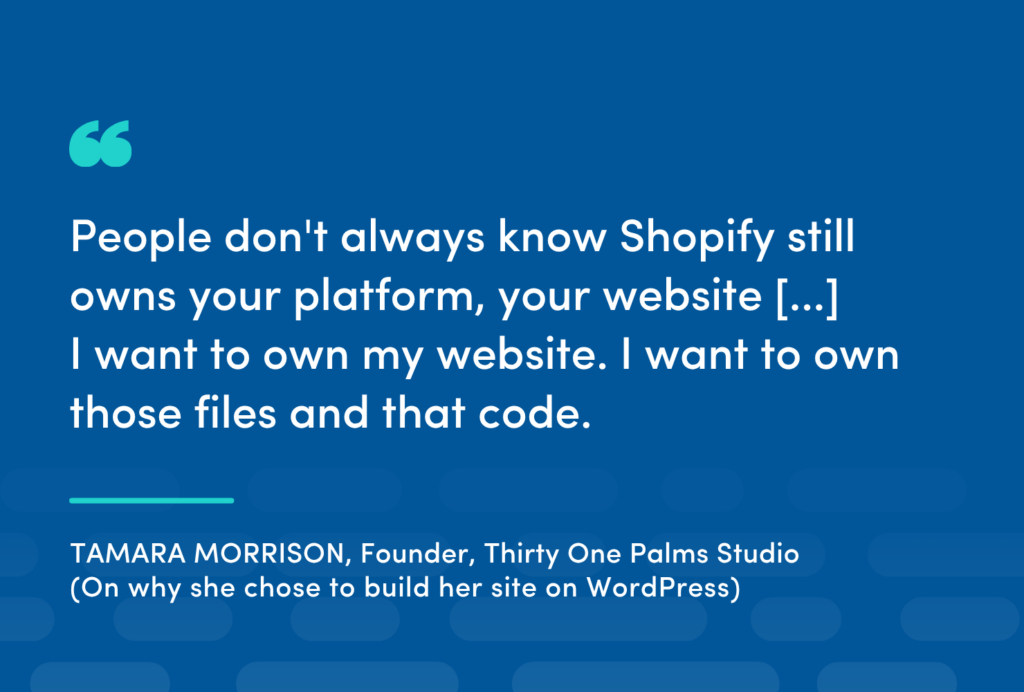
The bigger reason goes past preference. “People don’t always know Shopify still owns your platform, your website,” she says. “They can shut you down anytime they want to. You don’t actually own your website like Shopify does. So I want to own my website. I want to own those files and that code.”
It shows up in who buys from her, too. A lot of her customers arrive after a version of the exact scenario she used to run from herself: a freelance designer or web builder who took their money, did half the job, and disappeared.
“I hear that all the time,” she says. “It’s like half done and then the person just never responds again, and they don’t have any control over the project because they don’t know how to use the platform. They can’t log in.”
Her templates hand people back the control a stalled project takes away.
Where she sees the opening: AI slop is making original design more valuable, not less
Tamara agrees that AI-generated ads are backfiring on the businesses running them.
Her own read on where that leaves a business like hers is more specific than alarmed. She’s not anti-AI; she uses it constantly for research and answering customer messages faster.
“It gets to know you and gets to know your business,” she says, “and it kind of knows how to answer.”
What she doesn’t use it for is the actual design work customers are buying. “Even with all the stuff out there, the template route is still sort of the better, easier way to go,” she says, “especially if you’re templatizing everything, at least for now.”
That’s the opening she sees: as AI-generated ads get easier to spot and easier to tune out, a customized template that’s still been designed by an actual person, holds up better than an AI-generated one.
What any of this looks like in five or ten years, she won’t pretend to know. Shopify and Wix didn’t exist when she started designing. Something else will exist that nobody’s building templates for yet.
What she’s not uncertain about is the part that’s carried her this far, and it applies as much to the design as it does to the business itself: whatever she’s building, on whatever platform, it needs to actually be hers.
“I want to own my website,” she says. “I want to own those files and that code.”
Want to learn from more entrepreneurs like this? Check out our YouTube channel for the rest of our Business Founder Series, where we sit down with online business owners to hear how they got started, what’s working, and what they’ve learned along the way.





Add a Comment