


Here’s how membership site owners are using AI to catch at-risk members, fix payment problems, and boost retention before members walk out the door.
AI tools like MemberPress AI Foundation are changing how membership owners handle retention.
It connects your site to AI assistants using MCP (Model Context Protocol), so instead of digging through reports, you can just ask plain questions about your member data, like who’s at risk, why people are leaving, and when to step in.
You get an answer in seconds, and you can act on it in the same conversation.
In this blog post we’ll look at what you can ask your AI assistant to boost retention rates today!
Why Does AI Matter for Membership Site Retention Right Now?
Getting new signups is easy if your offer is good. Keeping those members is harder. Most owners don’t check their reports often enough to catch a problem before it makes a serious impact on their revenue.
And it’s understandable. Membership site owners have a ton of other responsibilities to manage. Checking reports is a time drain, and, let’s face it, an administrative chore many procrastinate on
MemberPress AI Foundation is an example of an AI solution that makes essential reporting quicker and easier.
It connects your site to AI tools like Claude Desktop, Cursor, and VS Code over MCP, the connection standard that lets AI assistants read and act on your data safely.
In plain terms, it lets an AI assistant read your membership data and, with your OK, take action on it. You ask a question the way you’d ask a coworker, and you get a real answer straight from your own site.
How Can AI Help You Spot Members Who Are About to Cancel?
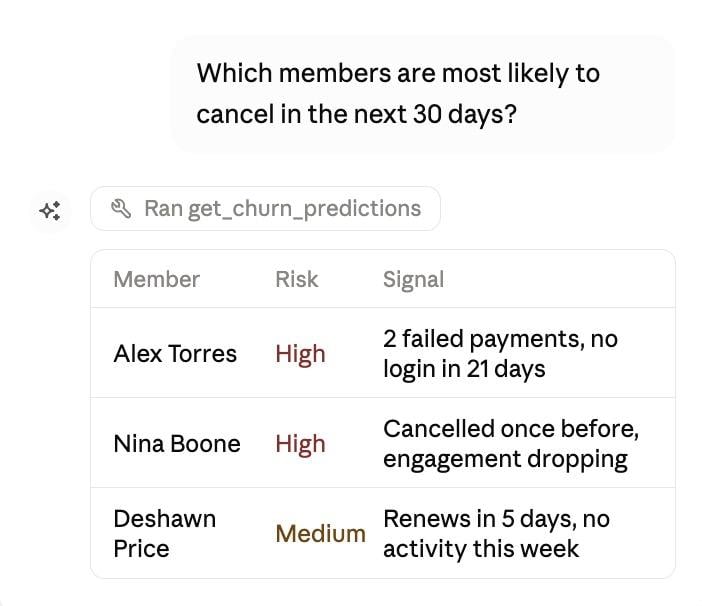
The early warning signs are already in your data. You just haven’t had time to dig them out. Ask questions like:
- “Which members are most likely to cancel in the next 30 days?”
- “Show me subscriptions expiring this month that haven’t renewed yet.”
- “Which membership plan has the highest churn rate right now?”
- “Compare this month’s cancellations to last month’s, and tell me what changed.”
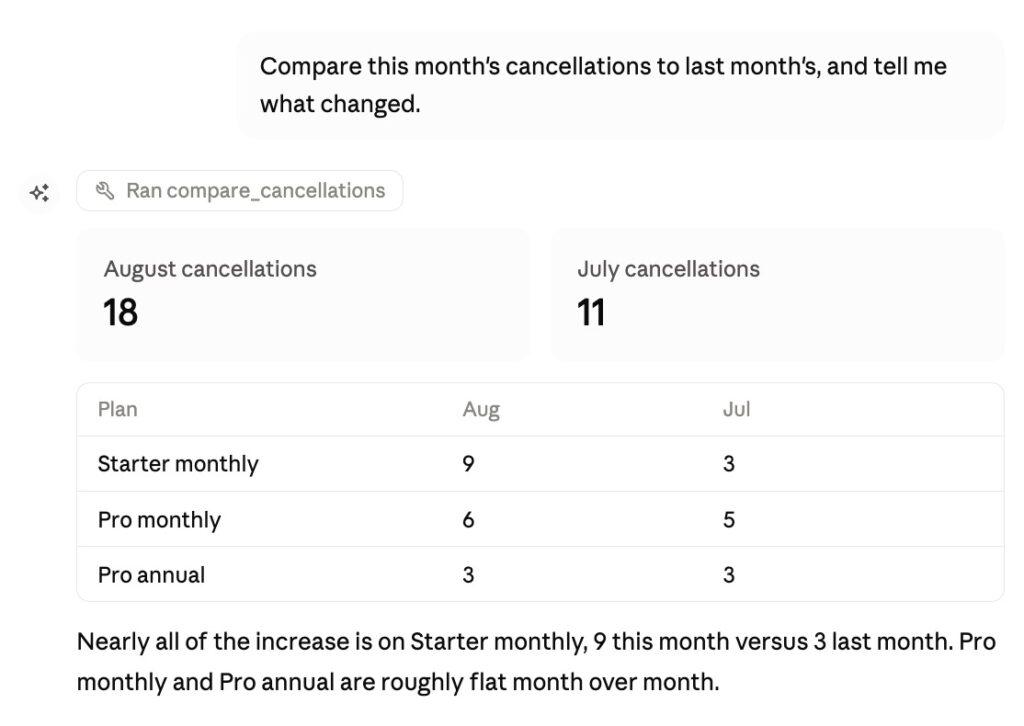
Once you know which plan is losing members, or which subscriptions are about to lapse, you’ve got a real list to work from. Not just a hunch.
Why Are Members Actually Leaving?
Knowing who’s at risk is only half the story. The bigger question is why. Comparing cohorts is one of the easiest ways to spot a pattern. A cohort is just a group of members who signed up around the same time.
- “Break down my churn by product, when are people canceling relative to signup?”
- “Group my members by signup month and show me how each cohort’s retention compares.”
- “What’s the average time before a member cancels, and does it differ by plan?”
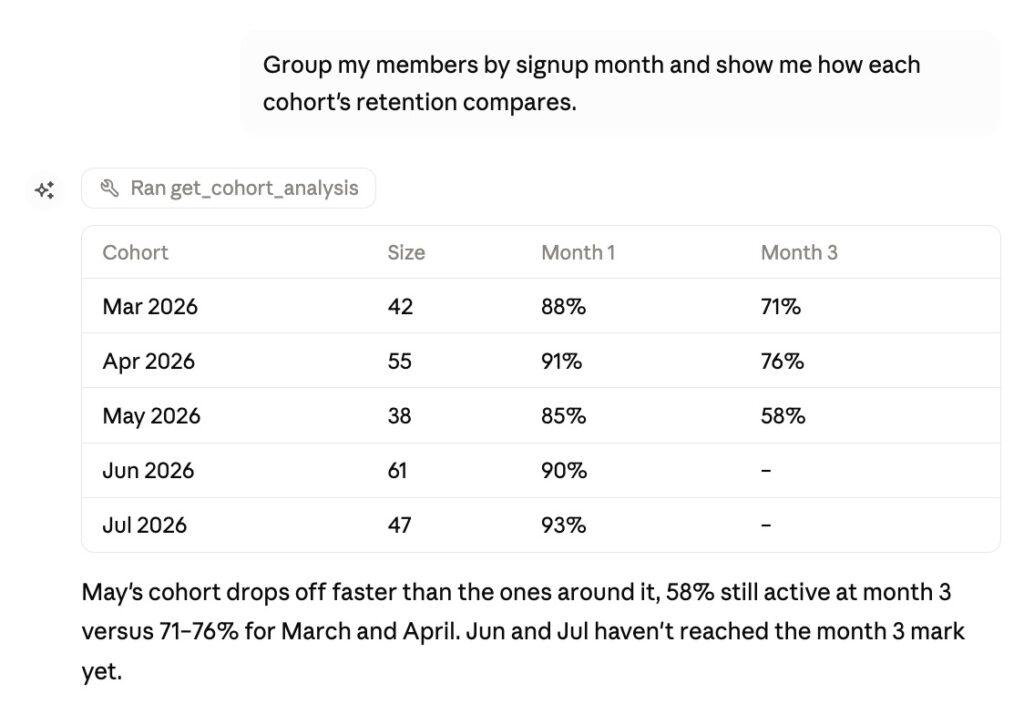
Say everyone who signed up in March cancels around week six. It usually means something in your onboarding, or the pace of your content, is losing people at the same point every time.
How Do You Catch Payment Problems Before They Turn Into Cancellations?
A lot of your “cancellations” aren’t really cancellations. They’re just failed payments nobody fixed.
- “Show me every failed payment this month and which gateway they came through.”
- “How does my failed payment rate compare to my successful transaction volume?”
- “Which members have a payment method that’s likely to fail soon?”
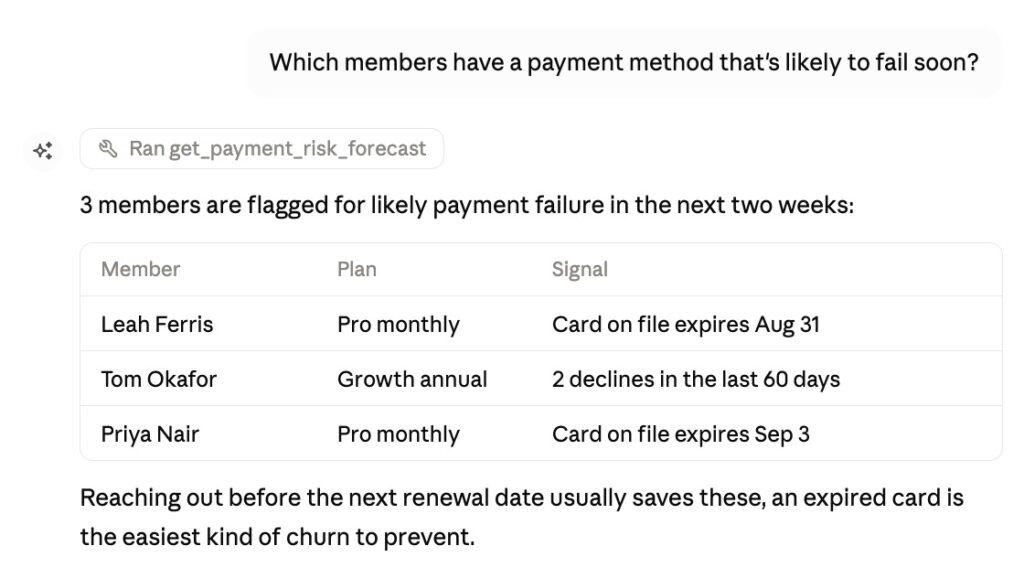
A member whose card expired isn’t trying to leave. Send one email before the subscription lapses, and they’ll often stay.
How Do You Close the Content Gaps Hurting Engagement?
For course-based memberships, churn is usually a content problem, not a billing one. People don’t cancel because the price went up. They cancel because they stopped making progress and lost interest.
- “Which courses have the lowest completion rates?”
- “Show me students who started a course but haven’t logged progress in 30 days.”
- “Which lessons are people dropping off at most?”
- “List students enrolled in [course] who are stuck and haven’t finished.”
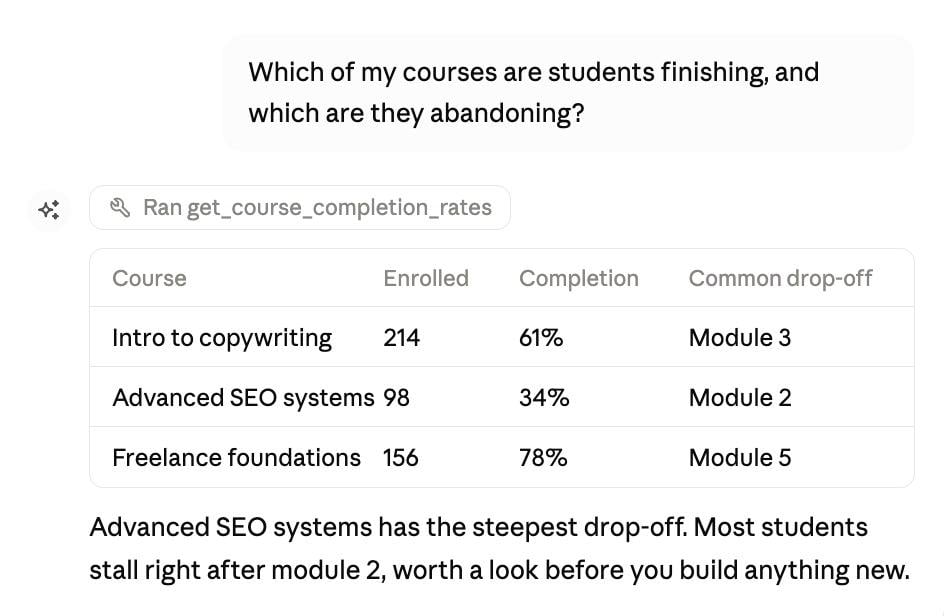
MemberPress Courses is what organizes that learning content in the first place. When it’s active, MemberPress AI Foundation can answer questions about lessons and drop-off too, the same way it answers questions about a failed payment.
How Do You Know Who to Re-Engage, and When?
Not every at-risk member looks like a cancellation risk yet. Some just go quiet first, and that quiet needs attention.
- “Which members have gone quiet, low transaction or login activity in the last 90 days?”
- “Show me upcoming renewals in the next 30, 60, and 90 days so I know who to reach out to first.”
- “Which members have the highest lifetime value, and are any of them at risk?”
Ask that last question often. Losing a brand-new member hurts less than losing someone who’s paid you for three years and just started slipping away.
How Do You Turn These Insights Into Retention Actions?
Finding the problem only helps if you actually do something about it.
- Ask a specific question, not a general one. “Who’s at risk” is a start, but “which members on my annual plan haven’t logged in for 60 days” gives you a list you can act on today.
- Check the preview before anything changes. Before an update happens, you’ll see exactly what’s about to change. That’s what makes it safe to let AI take action at all.
- Approve the action. Extending someone’s access, resuming a paused subscription, or refunding a failed renewal all happen right in the conversation once you say yes. Anything you can’t undo needs a second confirmation, so nothing happens by accident.
- Track whether it worked. Ask the same churn or renewal question again a few weeks later, and compare it to where you started.
Other Retention Questions You May Want to Ask:
Once you’re in the habit of asking, consider adding more specific questions to your list:
- “Which acquisition channel, ads, email, or referrals, has the best 90-day retention?”
- “Do members who signed up with a coupon renew at the same rate as full-price members?”
- “How has my failed payment recovery rate changed over the last two quarters?”
These can help you figure out whether your marketing and recovery efforts are actually paying off, or whether that budget and effort would be better spent elsewhere. Ask them every quarter and use the answers to fine-tune your strategy.
Frequently Asked Questions
Does asking AI Foundation questions about my membership data cost AI Credits?
No. Read-only queries, like checking churn rates or renewal dates, don’t consume AI Credits. Credits only come into play when the AI takes an action.
Can AI actually cancel or refund a member without me approving it first?
No. Routine changes show a preview before anything happens, and irreversible actions like refunds require a two-step confirmation, so nothing executes without your sign-off.
Do I need a developer to set up MemberPress AI Foundation?
No. It installs from the Add-ons section like any other MemberPress add-on, and it’s available on all three current MemberPress plans.
Does this work for course-based memberships, not just paid content sites?
Yes. When MemberPress Courses is active, the toolset expands to cover course and lesson-level data, so you can ask about completion rates and drop-off points the same way you’d ask about churn.
What’s the actual retention benefit over just running a report?
Speed. A report tells you what already happened. Asking the AI gets you the answer and lets you act on it right away, in the same conversation. That’s usually the difference between noticing a problem and actually fixing it.
What is MCP, and why does it matter here?
MCP stands for Model Context Protocol. It’s the connection standard that lets AI assistants like Claude Desktop, Cursor, and VS Code securely read your MemberPress data and take approved actions, instead of you copying numbers between a report and a spreadsheet by hand.
TL;DR
- MemberPress MCP (AI Foundation) lets you ask plain-language questions about churn, renewals, and payments, then act on the answer with built-in approval steps.
- Read-only questions (who’s at risk, what’s the churn rate) don’t use AI Credits. Only actions do.
- Failed payments often look like cancellations. Catch them early and you keep members who never meant to leave.
- For course memberships, low completion rates and lesson drop-off are usually the real churn driver, not price.
- Data collection on it’s own does nothing. The highest-value move is asking follow-up question and then actually doing something with the answer.
Get MemberPress Today!
If you’re ready to stop guessing why members are leaving, MemberPress AI Foundation gives you a direct MCP connection to your own retention data, along with the approval steps to act on it safely.

Get MemberPress Today!

If you found this article helpful, follow us on Facebook, X, Instagram, and LinkedIn!












Add a Comment