

Stop trading hours for dollars. Here’s how to package your business coaching into subscription models that scale, without burning out or pricing out your best clients.
Most business coaches start the same way – a few clients, the odd project, income that looks decent some months and disappears in others.
It works well enough until it doesn’t. Until you realize you’re spending as much time finding clients as you are coaching them, and the moment you stop selling, the income stops too.
Subscriptions solve that problem. Instead of starting from zero every month, you build a base of members who pay consistently – and who you can actually serve better because the relationship doesn’t reset every time a project ends.
This guide walks you through the subscription models that work specifically for business coaching, how to structure them, and how to set everything up so your membership runs without you managing it manually.
? Building a business coaching website? This guide is part of a full series covering every step, from choosing your niche to setting up your membership. The best place to begin is here ? How to Create a Business Coaching Website
Why Subscriptions Work Better Than One-Off Coaching Packages
There’s nothing wrong with one-off coaching engagements. But as a primary business model, they create three problems that compound over time.
1. The income problem. Project-based income is unpredictable. A good month followed by a slow month followed by a scramble to fill your pipeline is exhausting – and it makes it almost impossible to plan, hire, or invest in growing the business.
2. The relationship problem. When a coaching engagement ends, the relationship resets. You’ve done the work to understand a client’s business, their challenges, their goals – and then they’re gone. The next client starts from scratch. Subscriptions let you go deeper with clients over time, which is where the real coaching value lives anyway.
3. The selling problem. One-off clients require constant selling. A subscription base doesn’t. Once someone is in, they stay until they actively decide to leave – which means your energy goes into coaching, not prospecting.
Here’s the mindset shift that makes subscriptions work: you’re not selling your time anymore. You’re selling ongoing access to your expertise, your frameworks, your community, and your guidance. That’s a fundamentally different offer – and one that scales in a way that trading hours for dollars never will.
Business coaching is particularly well-suited to this model because business problems don’t get solved in one session. They evolve.
A client who’s working through a hiring challenge this quarter will be working through a management challenge next quarter. The problems keep coming – which means the value of having a coach keeps compounding.
The Business Coaching Subscription Models That Actually Work
There’s no single right model for every business coach. The one that works depends on your capacity, your niche, and the kind of experience you want to deliver. Here’s an honest breakdown of each.
One-on-one retainer coaching
A client pays a fixed monthly fee for regular access to you – typically a set number of sessions per month with support in between. Personal, premium, and limited by your calendar.
This works best for established business owners and executives who need ongoing strategic support and are willing to pay for it.
The ceiling is real – you can only take on so many clients before you’re full. But the income per client is high enough that you don’t need many to build a solid base.
Include monthly sessions, the ability to message you between calls, access to your resource library, and session recordings.
Price it at a level that reflects the access. Too low and you attract the wrong clients.
Group coaching programs
Instead of working with clients individually, you bring a group of 8 to 20 business owners through a structured program together – with live sessions, shared resources, and the accountability that comes from working alongside people facing similar challenges.
A well-run group program can feel surprisingly personal without requiring individual time with every member.
Clients often learn as much from each other as they do from you.
You can run it as a fixed-term program where everyone starts and finishes together, or keep enrollment open so new members can join at any time.
Fixed-term programs tend to build stronger group dynamics. Open enrollment is easier to sell because there’s no waiting for the next start date.
Mastermind groups
A small group – typically 8 to 12 high-level business owners – who meet regularly to work through each other’s challenges.
Your role is to facilitate, not lecture. You hold the space and make sure every member gets real value from every session.
Masterminds command the highest prices of any group model because the value isn’t just your coaching – it’s the room.
Who else is in the group, what they’ve built, and who they know. When you curate the right people, members will pay a significant monthly fee just to be part of that conversation.
A self-serve membership with no live sessions
Not every business owner wants to book calls or show up to group sessions. Some want access to your resource library, courses, and community on their own schedule.
A self-serve tier makes that possible at a lower price point and creates a natural entry point into your higher-ticket offerings.
There’s no calendar to manage, no sessions to run, and no cap on how many members can join. It works best as part of a tiered structure – not as your only model.
Combining models into tiers
Most successful coaching memberships stack two or more of the above.
A common structure:
- a self-serve entry tier with the library and community,
- a group coaching tier that adds monthly live sessions and a structured program, and
- a one-on-one tier for clients who want direct personal access.
Each tier feeds the next. Entry-tier members who get value move up to group coaching. Group coaching members who want more direct support upgrade to one-on-one. The whole structure becomes a natural progression rather than a single take-it-or-leave-it offer.
How to Design a Simple Membership Tier Structure
The most common mistake coaches make with tiers is over-engineering them before they have any members.
Start simple – two tiers are enough to test the market, three is a complete offer stack. More than three, and you’re making the decision harder for the person considering joining.
Here’s what a straightforward tier stack looks like for a business coach:
- Entry tier – $X/month: Access to the full resource library, community, and any self-paced courses. No live sessions. Best for business owners who want to learn at their own pace before committing to something bigger.
- Group coaching tier – $X/month: Everything in the entry tier, plus monthly group coaching sessions and direct access to you in a group setting. Best for business owners who want live coaching and accountability without the price of one-on-one work.
- One-on-one retainer tier – $X/month: Everything in the group tier, plus monthly individual sessions and the ability to message you directly between calls. Best for established business owners who want personal, ongoing strategic support.
- Make the upgrade path feel obvious: Every tier should make the next one look like a natural step up.
The gap between tiers should be clear – not just in price, but in what the member gets and how much access they have to you.
If someone has to think hard about what they’d gain by upgrading, the tiers aren’t different enough.
- Don’t give too much away at the entry level: The entry tier needs to deliver real value – enough that someone feels good about paying for it. But it shouldn’t deliver so much that there’s no reason to upgrade.
Your resource library and community belong at the entry level. Your time – even in a group setting – belongs in a higher tier.
How to Set Up Business Coaching Subscriptions in MemberPress
If you haven’t installed MemberPress yet, the previous guide in this series covers the full setup from scratch – Setting Up WordPress for a Business Coaching Site.
If you’re already set up, here’s how to create your coaching subscription tiers specifically. Go to MemberPress → Memberships → Add New for each tier.
Name it clearly and set the price and billing type. Monthly recurring is the default for most coaching memberships, but annual billing is worth offering as an option from the start.
Once each tier is created, go to MemberPress → Rules → Add New to control what each tier can access.
- A basic member gets the resource library and community.
- A group coaching member gets everything in the entry tier, plus the group coaching portal and session booking link.
- A one-on-one member gets all of the above, plus their private booking page.
The rules engine handles all of this automatically – no manual access management on your end.
Turn Your Membership Into a Coaching Program
MemberPress handles your membership infrastructure. CoachKit™ handles the coaching side – and the difference matters.
Without CoachKit™, you have a membership site that delivers content. With it, you can:
- run structured coaching programs,
- group clients together,
- set milestones,
- track individual progress,
- and message clients directly
…all from your WordPress dashboard.
Here’s what each feature actually does:
- Group management: Organize your clients into groups by enrollment date, program type, or coaching level. Each group has its own coach, timeline, and milestones. You can run several groups at once without losing track of where each one is.
- Milestones and habits: Milestones are the key goals clients should hit by specific dates. Habits are the recurring tasks that keep them on track between sessions. Together they give clients a visible sense of progress – and give you a way to spot who’s falling behind before they quietly cancel.
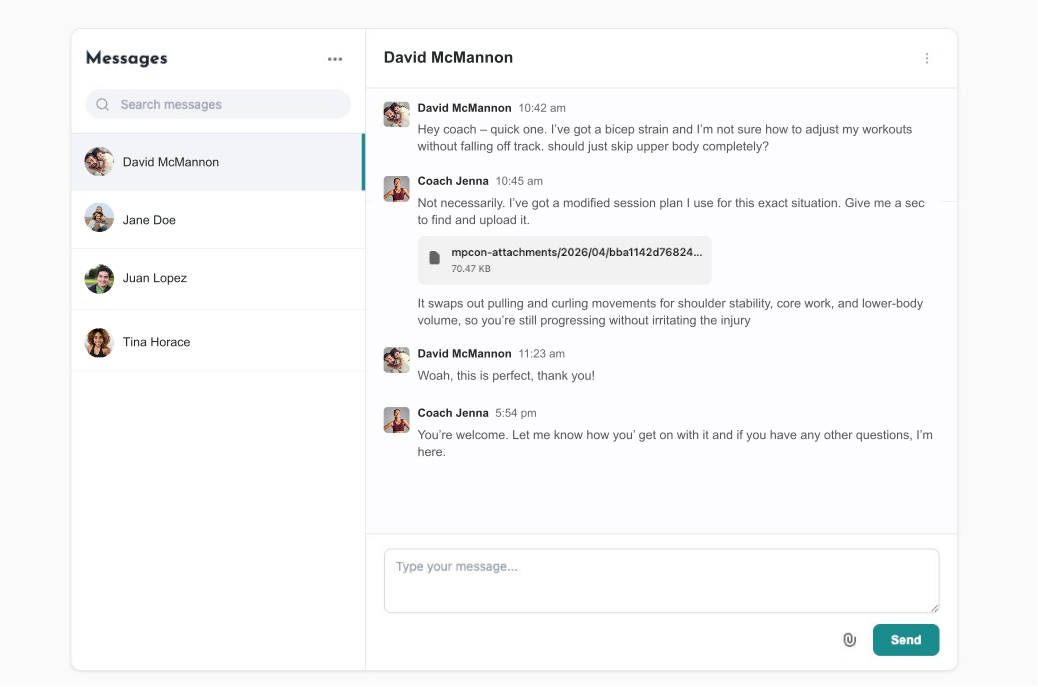
- Direct messaging: Clients can message their coach from inside the membership – no jumping to email or WhatsApp, or messages getting buried.
Everything stays in one place, and the coaching relationship feels more connected between sessions.
You can even use messaging to send files directly to your clients.
- Progress tracking: From your CoachKit™ dashboard, you can see exactly where every client is. When someone goes quiet, you’ll know before they churn.
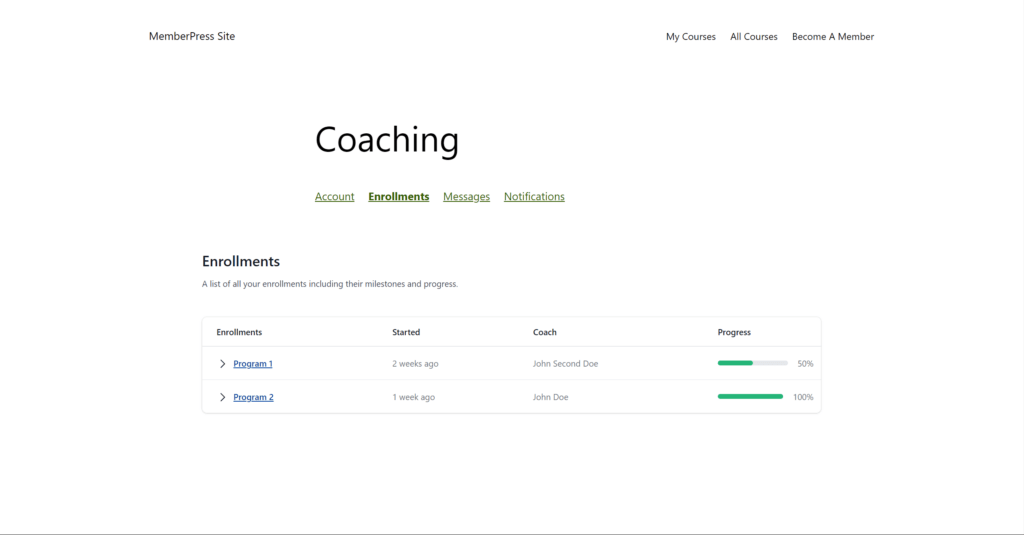
The McCance Method is a real example of what this looks like in practice. She uses CoachKit™ to run fully automated, scalable coaching programs – from cohort enrollment to milestone tracking and client messaging – all without manually managing access or chasing clients for updates.
CoachKit™ is available on MemberPress Growth and Scale plans.
Run Live Coaching Sessions and Scheduling Without a Headache
Live sessions are where a lot of the coaching value happens – and where the admin headache lives if you don’t set things up properly from the start.
- Protect your booking links: Never share a public booking link. Set up your scheduling tool – Simply Schedule Appointments or Acuity Scheduling – and protect the booking page with a MemberPress rule so only active members of the right tier can access it.
A basic member shouldn’t be able to book a one-on-one session. A retainer member should find their booking link waiting the moment they log in.
- Live session tools: Zoom is the most widely used option and works cleanly with both Simply Schedule Appointments and Acuity.
Jitsi is a free alternative if you’d prefer not to rely on a third-party platform. Either way, the session link should generate automatically when a member books – not something you send manually.
- Turn recordings into library content: Every group session recording is a piece of content.
Once a session ends, upload the recording to your resource library and protect it with the same membership rules as the rest of your content.
Members who missed the session can catch up. Members from previous groups get a growing archive to reference.
The coaching you’re already delivering becomes something that compounds over time.
How to Set the Right Price for Your Business Coaching Subscriptions
Pricing is where most coaches undercharge – and the consequences build over time. Low prices attract price-sensitive clients, create more support work, and make it harder to deliver a quality experience. Here’s how to think about pricing by model.
- One-on-one retainer coaching: Price based on the access and the outcome, not the number of sessions. A monthly retainer for an established business owner should reflect the strategic value you’re delivering – not your hourly rate multiplied by session count. Four sessions a month at a premium rate is a fundamentally different offer from four sessions buried in a cheap all-in-one plan.
- Group coaching programs: The most common mistake here is charging too little because it feels like members are getting less than one-on-one work. They’re not. They’re getting peer accountability, a structured program, and a community, which often delivers better outcomes than occasional individual sessions. Price group coaching at a level that reflects that, not as a discounted version of your one-on-one work.
- Self-serve tiers: Price low enough to be an easy yes for someone who’s just discovered you – but not so low that it signals the content isn’t worth much. A self-serve tier should feel like a considered decision, not an impulse buy.
- Annual vs. monthly billing: Offer annual billing at a discount – typically the equivalent of one to two months free. Mention it at checkout and in your onboarding emails. Annual members cancel at a fraction of the rate of monthly members, and the upfront cash flow gives you more to work with. Once your membership is running, Baremetrics is worth setting up – it gives you a clear view of your monthly recurring revenue, churn rate, and lifetime value by tier, so you can see exactly where you’re growing and where you’re losing people.
- Free trials: A free trial on a self-serve tier can work well – members get to explore the library before committing, and conversion from trial to paid tends to be higher than from a cold sign-up. Avoid free trials on group coaching or one-on-one tiers. The bar to entry for high-touch programs should be a committed payment.
Before You Go
Your subscription model is set up, and your coaching programs are running. Now it’s time to add the next layer – courses. Content you build once and sell indefinitely, to members and non-members alike.
The next guide in this series walks you through how to build and sell online business courses with MemberPress.
? How to Build and Sell Online Business Courses with MemberPress
If you’re ready to set up your business coaching subscriptions, MemberPress gives you everything you need – membership tiers, content protection, CoachKit™ for your coaching programs, and payment processing all in one place.
Get MemberPress Today!
Start getting paid for the content you create.










Add a Comment