


The right business coaching niche determines who joins your membership, why they stay, and how much they’ll pay.
You can help a lot of people and still build a struggling membership business. It happens more than you’d think – a coach with real expertise, a decent following, and a genuine desire to help, who can’t seem to get members to stick around past the first month.
Most of the time, the problem isn’t the coaching. It’s the positioning. “I help entrepreneurs succeed” sounds reasonable until you realize nobody is searching for that, nobody feels like it was written for them, and nobody has a strong reason to keep paying for it.
Memberships work when the problem you solve is specific, ongoing, and something your ideal member can’t easily fix on their own.
This guide helps you nail down exactly who you serve and what you help them do – so when you’re ready to build your coaching business, you’re building it around something people will actually pay for month after month.
? Building a business coaching website? This guide is part of a full series covering every step, from choosing your niche to setting up your membership. The best place to begin is here ? How to Create a Business Coaching Website
Why Your Membership Needs a Clear Niche to Work
A general coaching practice can survive on referrals. Someone hears about you, the fit is good enough, you do the work, and they move on. You don’t need a tight focus for that to work.
A membership is different. People are paying you every month, which means they need a clear, ongoing reason to stay. And “general business advice”, however good it is, rarely gives them that reason.
When someone joins your membership, they’re buying the belief that this program was built for someone like them, with a problem like theirs.
A freelance designer trying to raise her rates wants to feel like your membership was made for her – not like she has to sift through content meant for everyone else to find the parts that apply.
The more specific your focus, the easier it is for the right people to recognize themselves in your offer – and the easier it is for you to create content they actually want to consume every week.
Niching down makes your entire membership easier to run because you always know what to create, who you’re creating it for, and what would make them stay.
How to Choose the Right Niche for Your Coaching Business
Choosing a niche is about finding the spot where three things overlap:
What you genuinely know
You’re going to be coaching, creating content, and answering questions on this topic for years. If you’re stretching beyond what you actually know, your members will feel it – and they won’t stay.
What a specific group of people is struggling with
Not what you think they need, but what they’re actively stuck on right now and can’t easily figure out on their own. The clearer you are about this, the easier everything else becomes.
What people will keep paying to solve
Some problems get fixed once and go away. A good membership niche has ongoing problems – the kind where solving one challenge naturally leads to the next. That’s what keeps members subscribed month after month.
When those three things line up, you have something worth building on. But when one of them is missing (you’re passionate about it, but there’s no real demand, or there’s demand, but the problem gets solved too quickly), the membership will always feel like an uphill battle.
Take time with this part. It’s the decision that everything else sits on.
Four Ways You Can Niche Down as a Business Coach
Here are the four most common approaches to niche down as a business coach – pick the one that feels most natural to how you already think about your work.
1. Audience-focused – you niche by who you help
This is the most straightforward approach. You pick a specific type of person and build everything around them.
- Freelancers building their first service business
- Female founders in the early stages of scaling
- Health and wellness practitioners who struggle with the business side
- Consultants transitioning out of corporate employment
2. Stage-focused – you niche by where your clients are in their journey
Instead of who they are, you focus on where they are. Every business stage comes with its own set of challenges – and coaches who specialize in one stage become the obvious choice for people in it.
- Early-stage founders trying to get their first consistent clients
- Established businesses are ready to hire and stop doing everything themselves
- Business owners preparing to sell or exit
3. Industry-focused – you niche by the field your clients work in
You become the go-to coach for a specific industry. This is one of the most powerful ways to position yourself, and one of the clearest examples of it working is Lesley Logan.
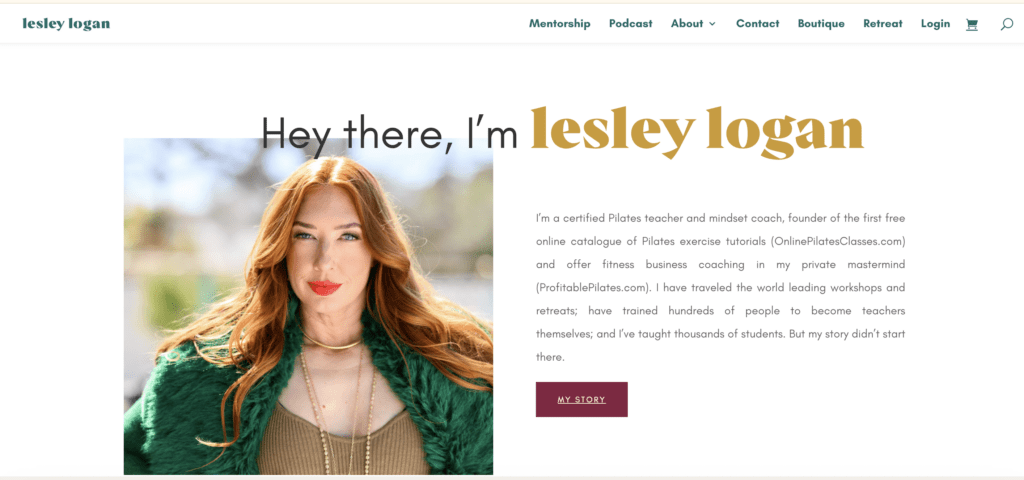
She’s a certified Pilates teacher who noticed that most Pilates instructors had no idea how to run a profitable business.
So she built a coaching program with MemberPress specifically for them, teaching fitness business owners how to get clients, set their rates, and build a practice that’s actually sustainable.
That focus made her the obvious choice for an entire industry. She’s now booked through 2028.
- Business coaching for creative agencies
- Coaches for real estate professionals
- Coaches for health and wellness practitioners
4. Outcome-focused – you niche by the specific result you deliver
You’re not defined by who your clients are – you’re defined by the results they get.
- Helping service-based businesses generate consistent leads
- Helping undercharging professionals fix their pricing
- Helping solo operators make their first hire
Any of these can work. What doesn’t work is trying to be all of them at once – because then you’re back to being a general business coach, and we’re right back where we started.
Don’t Build Around a Niche Until You’ve Tested This
Before you start creating content or building out your membership, you need to know that people will actually pay for what you’re planning to offer.
Here’s how to check:
- Look for existing paid products in the space: Search for books, courses, group programs, and paid communities in your niche. If people are already spending money there, that’s a good sign – it means there’s a proven market.
No competition sounds appealing, but it usually means there’s no demand either.
- Go where your potential members already hang out: Look at Reddit threads, Facebook groups, and online communities where your target audience spends time.
What questions keep coming up? What are people consistently stuck on? The problems that get asked about over and over are the ones worth building a membership around.
- Have real conversations with real people: Find five to ten people who fit your ideal member profile and talk to them – not a survey, an actual conversation.
Ask what they’re struggling with, what they’ve already tried, and what they’d pay to solve it. You’ll learn more in one honest conversation than in weeks of desk research.
Define Your Ideal Member (and Be Specific)
Picking a niche tells you what your membership is about. Defining your ideal member tells you who it’s actually for – and that distinction matters more than most coaches realize.
This isn’t about demographics. Knowing your member is a 35-year-old woman based in Austin doesn’t tell you what she needs from your membership or why she’d stay subscribed. What you actually need to understand is:
- What problem is she dealing with right now?
- What has she already tried that hasn’t worked?
- What does she feel like she’s missing that other people in her field seem to have figured out?
- What would her business look like six months from now if your membership actually worked for her?
When you can answer those questions clearly, every decision you make becomes easier – what content to create, how to structure your tiers, what to charge, what to say in your marketing. You’re not guessing anymore. You have a real person to write for.
Here’s what that looks like in practice:
Niche: Pricing strategy coaching for freelance designers
- She’s been charging the same project rates for two years, even though her skills have grown significantly
- She’s Googled “how to raise my rates” more times than she’d like to admit, but freezes when it comes to actually doing it
- She keeps losing projects to cheaper designers and can’t figure out whether to lower her prices or hold her ground
- She doesn’t want to freelance forever – she wants to build something more stable
- Success looks like consistent clients, a rate she’s proud of, and never feeling like she has to apologize for what she charges
That’s someone you can build an entire membership around. “Business owners who want to grow” is not.
How to Stand Out in an Overcrowded Market
There are a lot of business coaches out there. And most of them sound exactly the same.
The way to stand out is to be clearer than everyone else about who you help and what they walk away with. That clarity is what makes the right person stop scrolling and think “this is for me.“
Your positioning should lead with what your member gets, not what you’ve achieved. Certifications and years of experience might build trust once someone is already interested – but they’re not what gets someone interested in the first place.
Compare these two:
“Business coach helping entrepreneurs build better businesses.”
“I help freelance designers charge what they’re worth – and actually believe it.”
The second one works because it names a specific person, a specific problem, and the real barrier standing in their way.
Someone reading that either immediately thinks “that’s exactly me” or “that’s not for me at all.” Both are the right outcome. You want the wrong people to opt out just as much as you want the right people to opt in.
Your positioning doesn’t need to be a clever tagline. It just needs to be specific enough that the right person recognizes themselves in it the moment they read it.
What’s Next?
You know who you’re building for. Now you need to build the thing.
The next guide in this series walks you through how to set up WordPress for a business coaching site. You’d learn about hosting, MemberPress installation, the plugins that make a coaching site run, and the key pages you need before you launch.
The clearer your niche, the easier every decision after this one becomes. If you’re ready to start building, MemberPress gives you everything you need to set up your membership, protect your content, and get your first members through the door.

Get MemberPress Today!
Start getting paid for the content you create.








Add a Comment